
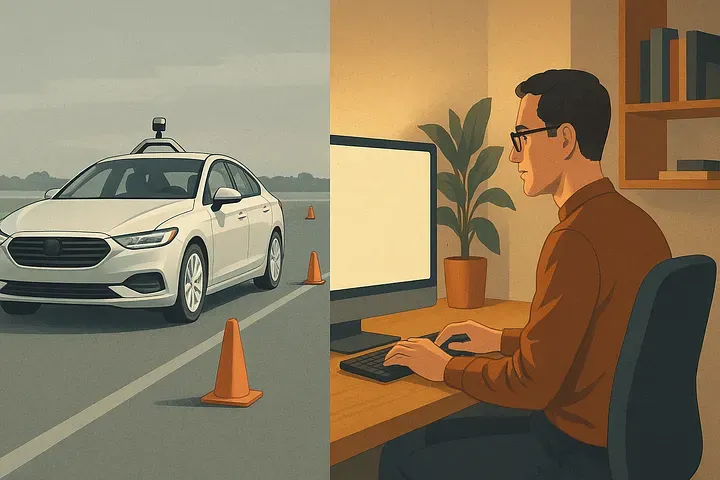
How AI went from perpetual “next year” promises to transforming how we actually work
The Tale of Two AI Eras
Imagine if I told you in 2016 that by 2025, millions of people would be collaborating with AI agents daily, completing complex tasks in minutes that once took hours. You’d probably nod politely and ask when the flying cars are coming.
Now imagine if I told you that fully autonomous vehicles — the poster child of AI innovation — would still be largely confined to a few carefully mapped city blocks after nearly two decades of development and hundreds of billions in investment. You’d think I was being pessimistic.
Yet here we are in 2025, living in both realities simultaneously. The AI revolution did happen, just not where we expected it.
The Golden Age of Autonomous Vehicle Promises
To understand how dramatically AI has shifted, we need to revisit the era when self-driving cars were the ultimate symbol of artificial intelligence. Google began its self-driving car project in 2009⁶, with founders Sergey Brin and Larry Page challenging engineers to drive autonomously without human intervention along ten challenging 100-mile routes in California. This wasn’t just a research project — it was AI’s moonshot moment.
The promise was intoxicating. The Society of Automotive Engineers had helpfully categorized autonomous driving into six levels, from Level 0 (no automation) to Level 5 (full automation where human intervention is never necessary, even in the most challenging environments). We had a roadmap. We had billion-dollar investments. We had Elon Musk.
Ah, Elon Musk. If autonomous vehicles had a hype man, it was Tesla’s CEO, who turned optimistic timelines into an art form. In April 2019, Musk confidently predicted Tesla would have robotaxis on the road in 2020, saying “I feel very confident predicting autonomous robotaxis for Tesla next year”⁷. When that didn’t happen, he kept doubling down. As recently as 2025, Musk confirmed plans for Tesla robotaxis on Austin roads by June, continuing a pattern of promises that stretches back nearly a decade.
A Wikipedia page grimly titled “List of predictions for autonomous Tesla vehicles by Elon Musk” tracks 21 promises or predictions with time horizons — 19 of which have failed to materialize, marked with red X’s¹. It’s a monument to the gap between AI aspiration and AI reality.
The Technical Mountain That Proved Too Steep
Why did autonomous vehicles become AI’s white whale? The technical challenges were more complex than anyone anticipated.
Self-driving requires multiple interconnected AI systems working flawlessly together: object recognition to identify pedestrians, vehicles, and road signs; tracking systems to follow objects through time; prediction algorithms to anticipate what other drivers might do; path planning to determine the vehicle’s trajectory; and control systems to translate decisions into steering and braking actions.
But the deeper problem was the “black box” nature of neural networks. Unlike traditional software with clear mathematical equations, AI systems provide outputs based on inputs without transparent reasoning — a significant challenge when split-second decisions affect human lives. When an autonomous vehicle makes a mistake, it’s nearly impossible to understand why or guarantee it won’t happen again.
The regulatory and liability questions multiplied these technical challenges. Who’s responsible when an AI driver causes an accident? How do you train systems for edge cases that happen once in a million miles? Even today in 2025, Waymo — the most successful autonomous vehicle company — operates at Level 4 autonomy in carefully mapped areas without harsh weather, extreme density, or complicated road systems.
Meanwhile, in a Different Corner of AI Land
While autonomous vehicles captured headlines and investment, something quieter was happening in AI research labs. Large Language Models (LLMs) were emerging, and they had a fundamentally different architecture that would change everything.
The breakthrough wasn’t just that LLMs could generate human-like text — it was their incredible flexibility. Unlike previous AI systems that required extensive training for narrow tasks, LLMs could be applied to diverse problems with minimal fine-tuning: content generation, analysis, translation, coding assistance, and even complex reasoning tasks.
Most importantly, LLMs operated at the level of human language and concepts. Instead of needing to engineer complex sensor fusion and real-time control systems, you could simply describe what you wanted in plain English. The barrier to AI adoption collapsed from “hire a team of AI engineers” to “write a clear prompt.”
The New AI Reality: From Hype to Utility
By 2025, AI has achieved something autonomous vehicles never could: mass practical adoption. Waymo, the leader in autonomous vehicles, provides about 250,000 paid trips per week across four cities². Meanwhile, GitHub Copilot has millions of individual users and tens of thousands of business customers, making it the world’s most widely adopted AI developer tool³.
The contrast is stark. AI coding assistants represent everything autonomous vehicles struggled to achieve:
Immediate Utility: Developers report 30–50% productivity improvements using AI-powered development tools⁴, with code completion, bug fixes, and even complex refactoring happening in real-time.
Scalable Deployment: Unlike robotaxis that require physical infrastructure, regulatory approval, and city-by-city rollouts, GitHub’s new coding agents can be assigned issues like human developers, working in the background with GitHub Actions and submitting pull requests for review.
Manageable Risk: When an AI coding assistant makes a mistake, it’s caught in code review. When an autonomous vehicle makes a mistake, people can die. The stakes made all the difference.
Rapid Iteration: Companies can experiment with different AI tools for various tasks — content generation, customer service, data analysis, and market research — adjusting and improving without massive infrastructure investments.

The Pattern Behind the Revolution
The real lesson isn’t that autonomous vehicles failed and AI coding succeeded — it’s that we learned what makes AI practically deployable at scale.
Andrej Karpathy, former Tesla AI director, perfectly captured this philosophy in his 2025 “Software 3.0” presentation using the Iron Man analogy. He noted: “What I love about the Iron Man suit is that it’s both an augmentation and Tony Stark can drive it. And it’s also an agent… But at this stage, I would say working with fallible LLMs and so on, I would say, you know, it’s less Iron Man robots and more Iron Man suits that you want to build. It’s less like building flashy demos of autonomous agents and more building partial autonomy products.”⁸
This insight crystallizes the difference between the autonomous vehicle approach and today’s successful AI applications:
Human-in-the-Loop Design: The most successful AI applications keep humans involved in meaningful ways. Copilot’s coding agent doesn’t replace developers; it handles routine tasks while developers focus on creative problem-solving and code review. This partnership model has proven far more effective than full automation.
Lower-Stakes Experimentation: AI excels when mistakes are recoverable. Content that can be edited, analyses that can be verified, and code that can be reviewed create safe spaces for AI to add value without catastrophic risk.
Language as the Interface: Modern LLMs operate at the level of human language, making them accessible to anyone who can describe a problem clearly rather than requiring specialized AI expertise. This democratization of AI capabilities has been transformative.
Incremental Value Creation: Instead of requiring perfect performance from day one, successful AI products provide immediate value that improves over time. A coding assistant that helps with 70% of tasks is immediately useful; an autonomous vehicle that works 70% of the time is unusable.
The Autonomous Vehicle Parallel Universe
This isn’t to dismiss autonomous vehicles entirely. Waymo continues expanding, with operations in Phoenix, San Francisco, Los Angeles, Austin, and Miami, plus plans for Atlanta, Washington D.C., and international expansion to Tokyo. The technology works within constrained environments and continues improving.
But the scope was always bigger than the technology could deliver in reasonable timeframes. Level 5 autonomy — the ability to drive anywhere, anytime, in any conditions — remains elusive after 15+ years of intensive development. The U.S. autonomous vehicle market is expected to grow from $22.60 billion in 2024 to $222.80 billion by 203³⁵, but this growth comes from expanding existing capabilities rather than achieving the original vision.
Lessons for the Next AI Wave
As we stand in 2025 looking at the AI landscape, the autonomous vehicle experience offers crucial lessons for emerging AI applications:
Beware of Moonshot Syndrome: The bigger and more revolutionary the AI promise, the more likely it is to hit unexpected complexity walls. The most successful AI products often start by augmenting human capabilities rather than replacing them entirely.
Context Matters More Than Capability: An AI system that works brilliantly in controlled environments may struggle catastrophically in the messy real world. Success comes from matching AI capabilities to appropriate contexts, not forcing AI into every possible use case.
Adoption Beats Perfection: AI tools that provide 80% solutions to common problems often create more value than AI systems pursuing 100% solutions to complex problems. Perfect can be the enemy of useful.
Infrastructure Integration Is Everything: The most successful AI applications integrate seamlessly with existing workflows and tools. They don’t require users to adopt entirely new processes; they make existing processes better.
The Real AI Revolution
Looking back, the autonomous vehicle hype taught us what AI couldn’t yet do. The LLM revolution taught us what AI actually could do, right now, at scale.
The difference wasn’t just technological — it was philosophical. Instead of trying to replace human intelligence entirely, the winning AI applications augment human intelligence selectively. Instead of requiring perfect performance in life-or-death scenarios, they provide imperfect but useful assistance in low-stakes environments where mistakes are learning opportunities.
As we move deeper into 2025, with enterprise adoption accelerating and new AI capabilities emerging monthly, the pattern is clear: practical AI beats promised AI every time.
The autonomous vehicle dream isn’t dead — it’s just taking the long road. Meanwhile, AI has taken a different route entirely, one that leads through our daily workflows rather than our driveways. And in doing so, it’s created something perhaps more valuable than robot chauffeurs: robot colleagues that make human work more creative, more efficient, and more fulfilling.
The future of AI isn’t in replacing us. It’s in making us better at what we already do.
What AI tools have transformed your workflow? Share your experiences and let’s discuss how practical AI is reshaping industries in ways we never expected.
References
¹ Wikipedia. “List of predictions for autonomous Tesla vehicles by Elon Musk.” Retrieved July 2025. https://en.wikipedia.org/wiki/List_of_predictions_for_autonomous_Tesla_vehicles_by_Elon_Musk
² TIME. “Waymo’s Self-Driving Future Is Here.” June 2025. Multiple sources also report Waymo providing over 250,000 paid trips weekly across Phoenix, San Francisco, Los Angeles, and Austin. https://time.com/collections/time100-companies-2025/7289599/waymo/
³ GitHub. “GitHub Copilot — Your AI pair programmer.” GitHub Copilot integrates with leading editors and has grown to millions of individual users and tens of thousands of business customers. https://github.com/features/copilot
⁴ HatchWorks AI. “Large Language Models: What You Need to Know in 2025.” February 2025. Reports indicate AI-powered development tools have increased software development productivity by 30–50%. https://hatchworks.com/blog/gen-ai/large-language-models-guide/
⁵ Research and Markets via Business Wire. “United States Autonomous Vehicles Industry Report 2025.” January 2025. Market analysis forecasts growth from $22.60 billion in 2024 to $222.80 billion by 2033, with a CAGR of 28.92%. https://www.businesswire.com/news/home/20250123408923/en/United-States-Autonomous-Vehicles-Industry-Report-2025-Waymos-Self-Driving-Taxis-Pave-the-Way-for-Adoption-with-Operations-Already-in-Phoenix-San-Francisco-and-Austin---Forecast-to-2033---ResearchAndMarkets.com
⁶ Waymo Blog. “In the driver’s seat: footage from our 2009–2010 1,000 autonomous mile challenge.” April 2020. Documents the founding of Waymo as the “Google Self-Driving Car Project” in early 2009. https://waymo.com/blog/2020/04/in-the-drivers-seat-1000-mile-challenge
⁷ CNBC. “Elon Musk claims Tesla will have 1 million robotaxis on roads next year, but warns he’s missed the mark before.” April 2019. Tesla Autonomy Investor Day presentation where Musk predicted robotaxis for 2020. https://www.cnbc.com/2019/04/22/elon-musk-says-tesla-robotaxis-will-hit-the-market-next-year.html
⁸ The Singju Post. “Andrej Karpathy: Software Is Changing (Again)” June 2025. Full transcript of Karpathy’s keynote at Y Combinator AI Startup School, where he introduced the Iron Man suit analogy for AI augmentation vs. autonomous agents. https://singjupost.com/andrej-karpathy-software-is-changing-again/

Member discussion: