
Is This You?
You’ve integrated GPT-4 into your app. Your RAG pipeline is returning “relevant” results. Your AI feature demo killed it in the all-hands meeting.
But here’s the million-dollar question: How do you know it actually works?
If you’re a developer racing to ship AI features, a tech lead responsible for production reliability, a founder betting your startup on AI, or a junior engineer trying to prove your model is ready — this playbook could save your product from becoming another AI cautionary tale.
The Pressure You’re Under
Let’s be real about what you’re facing:
- Developers: You need to ship fast, but AI isn’t like regular code. When your REST API fails, it returns a 500. When your AI fails, it might confidently return nonsense.
- Tech Leads: Your team is showing you notebooks with 95% accuracy. Your CEO is asking when it ships. You’re wondering what could go wrong in production.
- Founders: You’ve promised AI-powered innovation to investors. Your competitors are moving fast. But you can’t afford a PR disaster from AI gone wrong.
- Junior Engineers: You’ve fine-tuned a model, hit good metrics, but your senior engineers keep asking uncomfortable questions about “edge cases” and “production readiness.”
IBM lost over $4 billion on Watson for Oncology because the AI often gave unreliable or impractical treatment advice that didn’t match real-world medical practice. Doctors found it hard to trust or use, and the system couldn’t adapt well to different hospitals or countries. This failure shows why it’s essential to thoroughly test and evaluate new technology in real clinical settings before making big promises.
The “Deadly Accuracy” Trap
Let me share two stories from real AI projects that show why picking the right metrics matters:
Story 1: The Medical CT Scanner Project
We built an AI to detect lung tumors in CT scans. The technical approach: divide each 3D CT scan into small cubes, then classify each cube as tumor/healthy tissue.
What we measured initially:
- Dice score (segmentation accuracy on individual cubes)
- Performance looked “convincing” on our test sets
- Research papers would have loved these numbers
The reality check: CT scans are mostly healthy tissue. A lung tumor might affect a few hundred voxels out of hundreds of thousands. We trained on balanced datasets (roughly equal tumor/healthy cubes), but in real patient scans, the vast majority is healthy tissue.
When we finally evaluated on full patient CTs, the truth emerged. The model could achieve great accuracy by being good at identifying healthy tissue while missing actual tumors. As the project manager insisted: “The recall must be very strong, there cannot be false negatives”.
What actually mattered:
- Recall: Did we find all the tumors?
- Precision: Of what we flagged, how much was actually cancer?
- The goal: Help radiologists by never missing a tumor, even if it meant more false positives
Story 2: The Highway Trajectory Prediction Trap
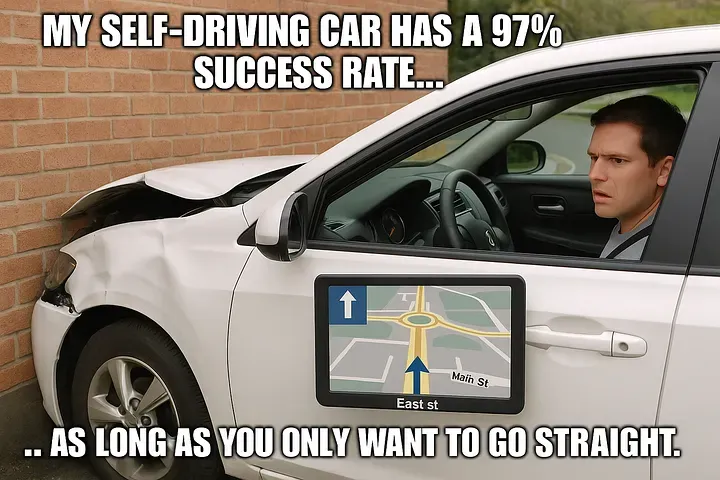
We built an AI to predict vehicle trajectories on highways — essentially guessing where cars would be in the next 5 seconds. The demo metrics were stunning: 97% accuracy on highway trajectory prediction.
The aha moment: When we dug into what the model actually learned, the truth was embarrassing. On highways, vehicles go straight most of the time. Our sophisticated deep learning model had discovered this one weird trick: always predict “vehicle continues straight.”
What this meant when we tested real scenarios:
- Vehicle ahead slowing down? → Model predicted it keeps going at same speed
- Car signaling to merge into your lane? → Model predicted it stays in its lane
- Your lane ending, need to merge? → Model predicted keep going straight
When I finally integrated it into our driving simulator, the car went straight off the road at the first curve. The model had never learned to handle anything except highway cruising.
What we measured later, instead of just accuracy:
- Performance on lane changes
- Accuracy during merging scenarios
- Ability to predict when vehicles slow down or speed up
- Edge cases that actually matter for safety
The Cost of Getting This Wrong
Imagine these scenarios:
- Your AI chatbot confidently gives wrong legal advice. A user follows it. Lawsuit incoming.
- Your content filter has 99% accuracy but lets through the 1% that gets your app banned from the App Store.
- Your AI-powered feature works great in demos but fails for 30% of real users. They churn to competitors who “just work.”
But flip it around — teams that get evaluation right:
- Ship with confidence because they’ve tested what actually matters
- Catch failures before users do with smart evaluation pipelines
- Build trust by being transparent about limitations
- Iterate faster because they measure the right improvements
Successful AI Development
Your first “successful” model is like your first draft of code that compiles — it runs, but it’s probably full of bugs you haven’t discovered yet.
The trajectory prediction model with 97% accuracy? That was our v1. The medical AI with great Dice scores? Also v1. These weren’t failures — they were starting points. The real work began when we stopped celebrating the metrics and started asking uncomfortable questions.
The AI Development Reality:
Just like software development, AI follows an iterative cycle:
- First run: You discover your model learned something completely different than intended
- Second run: You fix the obvious issues, only to uncover subtler problems
- Third run: You start catching edge cases you didn’t know existed
- Fourth run and beyond: You’re finally solving the actual problem
The difference? In traditional software, bugs throw errors. In AI, bugs hide behind beautiful metrics.
The Evaluation-First Mindset:
The teams that succeed treat evaluation like a debugger for AI. They:
- Build evaluation frameworks before celebrating any metric
- Expect their first model to have learned shortcuts
- Use each evaluation round to discover what’s really broken
- Iterate based on failure modes, not accuracy improvements
The medical team eventually built a system that caught tumors by focusing on recall over accuracy. The autonomous vehicle team created scenario-based tests that exposed the “always go straight” problem. But this only happened because they kept iterating after that first “successful” result.
The goal isn’t perfect AI — it’s AI that fails safely, recovers gracefully, and improves continuously.
Have an AI evaluation horror story or success story? Share it in the comments or join our community. The best lessons come from the trenches.

Member discussion: